Anode rods, inspection and replacement
Magnesium, aluminum, zinc, and powered anodes, when to change them, and when to stop pulling before the port breaks.
The anode rod is a metal electrode screwed into the top of a glass-lined steel tank. The glass lining cracks and pinholes over time. Exposed steel would rust.
The rod is made of a metal that corrodes more willingly, so the rod is consumed and the tank wall is not. When the rod is gone, the tank becomes the anode.
Rusty hot water and, later, a leak at the shell are the sequence. The color diagnosis is discolored hot water. The leak diagnosis is is the heater leaking. This page is the rod itself.
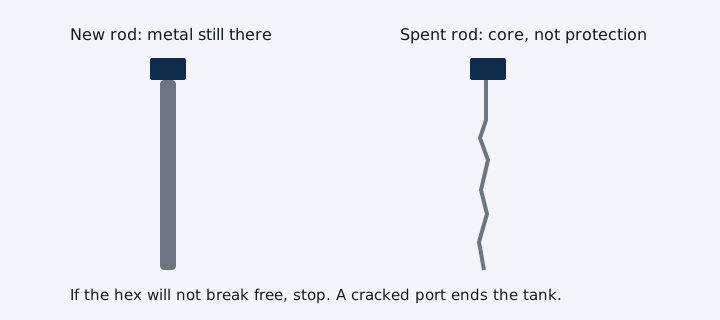
Manufacturers differ on the interval. A common instruction is to inspect within a few years and then on a schedule set by what the rod looked like, sooner on softened water or when a sulfur smell appears. A rod that still has substantial metal can go back in. A rod that is a thin core, or that is swollen into a mass of corrosion product, is due. Waiting for rust in the bathtub is a late inspection.
Which metal, and why smell changes the choice
Magnesium rods protect well in many waters and are the frequent factory choice. In water with sulfate-reducing bacteria they also make hydrogen sulfide obvious. The odor page explains how to prove the smell is the hot side and not a gas leak.
The anode change that usually follows is an aluminum rod or an aluminum-zinc rod, which protects the tank with less of that reaction. A powered anode uses a titanium electrode and a small power supply to impress a current, so there is no magnesium or aluminum being sacrificed in the same way.
It needs a receptacle and it costs more. It is the right tool when smell returns even after an aluminum-zinc rod, or when the owner wants a rod that is not a consumable in the same sense.
Softened water increases the rate at which a magnesium rod disappears. If a softener was added and nobody told the heater, inspect the rod within the year. The interaction is also in hard water and scale.
Do not remove the rod and plug the hole because the smell went away in a forum story. A tank without an anode is a tank on a countdown, and the warranty language usually says so. A weekend test with the rod out is only a test if a specified rod goes back in.
Match the replacement to the heater. Length, diameter, and thread are not universal. A rod that is too long for a short tank will not install.
A rod with the wrong thread will ruin the port, which ruins the tank. Segmented or flexible rods exist for closets with no headroom. Use one when a one-piece rod cannot come out without cutting a hole in the ceiling.
The manual or the manufacturer’s parts list for that model is the shopping list. This site does not link to stores. The parts counter that can see your data plate is the right counter.
Getting it out without wrecking the tank
Turn the energy off. Shut the cold inlet. Open a hot faucet and let pressure off. You do not always have to drain the entire tank, but you do have to accept that a few quarts will come out the anode port, and those quarts are hot.
A hose on the drain, with the drain cracked, lowers the level below the port if you want a drier job. Have towels and a pan.
The hex on most residential rods takes a 1-1/16-inch socket, and some do not. Confirm before you round the hex off with the wrong tool.
The rod may be tight beyond what a short ratchet can do. A breaker bar is fair. An impact wrench is fair if you can keep the socket square.
What is not fair is a cheater pipe on a rounded hex, or heat from a torch on the top of a tank. If the hex will not break free with a solid setup, stop.
A twisted-off head or a cracked glass lining around the port is a new water heater.
That risk is why many people hire the first anode job and do later ones themselves once they know the port is willing.
When to call a pro includes this moment on purpose. The part costs little. The tank costs the installed price in the cost guide.
When the rod comes out, look at it in good light.
A rod with a core showing along most of its length is spent. A rod that is coated but still thick can be reused if the threads and the seal are sound. Clean the port threads without gouging them.
Install the new rod with the sealant or tape the manufacturer specifies, not with a random pipe dope that is not for potable water. Tighten to the manual’s sense. Over-tightening cracks fittings. Under-tightening leaks the moment the tank is pressurized.
Refill, bleed air at a hot faucet until the stream is solid, and only then restore electric power. Gas controls go back to on per the lighting sticker if you shut them off. Check the anode hex for a drip during the first heat.
A drip at the hex is a seal problem you can fix now. A drip at the jacket seam is not. Do not leave the old rod in the drain pan as a souvenir that blocks the pan drain.
Clearance, combination rods, and tanks that hide the hex
Some heaters put the anode under a sheet-metal cap. Some combine the hot outlet and the anode so the outlet nipple is the rod. Those combination units surprise people who look for a second hex and conclude they have no anode.
The manual’s exploded view is the map. If you cannot find a hex, do not drill a new port. You are not adding an anode location the lining was not built for.
Overhead clearance is the other trap. Measure before you buy a rigid rod. A segmented rod installs through a shorter gap and still needs a straight pull.
In a closet under a stair, a powered anode or a flexible rod may be the only replacement that does not involve cutting structure. A plumber who has done that closet before is cheaper than a drywall repair plus a tank leak from a botched port.
Checklist: anode replacement
- Confirm the smell is not gas before you attribute odor to the rod. Leave the house if you are unsure.
- Energy off, cold water off, pressure relieved, water level managed.
- Correct socket, square on the hex. Stop if it will not break free.
- Replace magnesium with aluminum-zinc or a powered anode when sulfide odor is the complaint and the manufacturer agrees for that model.
- Never return the tank to service with the port plugged and no anode.
- Potable-rated seal, threads undamaged, hex dry after refill.
- Electric power only after a solid stream at a hot faucet.
- Record the date. The next inspection is sooner on softened water.
What a new rod cannot do
It cannot patch a tank that is already leaking at a seam. It cannot reverse rust that has already left the steel into the piping, though it can slow the next stage.
It cannot change a first-hour rating. It will not stop scale from forming on elements. Scale is the hard-water page and the flush. The rod is only the galvanic protection.
Tanks that ship with two rods, or with a rod and a powered anode option, are telling you the water in some regions eats the first rod quickly. Follow that hint if you live there.
If the hot water is already brown and the rod comes out intact, look at galvanized piping and the supply, because the rod was not the source. The discoloration page walks that split.
Keep the receipt and the date with the heater’s manual. Tank warranties often require an anode and sometimes require proof you maintained it. The shapes of those warranties are in how long heaters last. A rod installed and not written down is a rod you will argue about later.
Sources
Manufacturer owner’s and service manuals on anode type, combination outlet rods, and warranty conditions (A. O. Smith, hotwater.com; Bradford White, bradfordwhite.com; Rheem, rheem.com). U.S. Department of Energy, Energy Saver, storage-tank description and service life, as the reason the lining-and-anode system exists. Sulfide-odor technical notes from those same manufacturers, applied together with the smell guide rather than as a reason to run the heater with no anode.