How a storage-tank water heater works
The path of a gallon through a tank heater, from dip tube to flue or element, and which parts fail first.
A storage water heater is a steel tank that keeps a reservoir hot so two fixtures can draw at the same time. It is not an endless source. When the stored water is gone, you are left with whatever the burner or the elements can reheat while you wait, which is the recovery rate.
The Department of Energy’s consumer comparison lists a typical service life of about 10 to 15 years for this kind of heater, with standby loss as the price of the reservoir. Understanding the parts makes the later symptom pages shorter, because a broken dip tube, a spent anode, and a failed lower element are three different complaints.
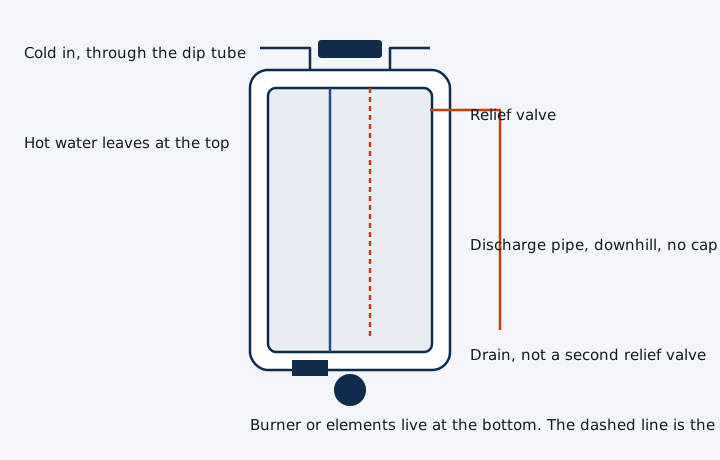
The tank itself is carbon steel with a glass lining baked onto the wet side. The lining is not a structural shell and it is not perfect. Pinholes and cracks in the glass are expected over time, which is why a sacrificial anode hangs in the water.
The jacket you see is thin sheet metal over insulation, usually foam. Water on the outside of the jacket can be a leak from a fitting, condensation, or water that has already escaped the steel and found a seam in the jacket. Telling those apart is the job of the leak guide, not of this page.
Where the cold water goes
Cold water enters through a dip tube, a plastic or sometimes metal pipe that opens near the bottom. The point of the tube is stratification. Hot water is less dense, so it parks at the top, where the hot outlet is.
New cold water is delivered to the bottom, where the heat source is, and does not stir the hot layer into a lukewarm mix. When a dip tube cracks or falls off, cold water dumps in at the top.
The first minute of a draw still feels hot, because a little hot water was waiting at the outlet, and then the tap goes lukewarm even though the bottom of the tank may be hot. That pattern is diagnosed in hot water that runs out too fast.
On top of the tank you will usually see a cold-side shutoff, a hot outlet, and sometimes a vacuum-relief or heat trap. Dielectric unions or plastic-lined nipples exist because joining copper directly to a steel tank fitting invites galvanic corrosion. Many current tanks ship with lined nipples.
Wrenching on a corroded nipple until the tank threads tear is a way to turn a fitting leak into a tank replacement. If the leak is at the threads and the port is pitted, assume the worst until a plumber says otherwise.
Gas heat and electric heat are different engines
An atmospheric gas tank has a burner under the tank, a flue up the middle, and a draft hood on top where room air joins the exhaust on its way to the vent.
The burner fires when the thermostat in the gas control calls for heat, runs until the water at the sensing point is satisfied, and shuts off. Combustion products must leave through a vent that drafts. The room must supply combustion air.
Those requirements are safety equipment, described in venting and carbon monoxide, not optional accessories. Standing-pilot controls keep a small flame lit to heat a thermocouple. Newer controls use a hot-surface igniter or a spark and prove the flame electronically. A page written for a thermocouple will not fix a flame-sensor unit.
An electric tank has one or two sheathed elements screwed into the side, each with a thermostat. On a common two-element residential heater the upper thermostat has priority. It heats the top of the tank first and only then powers the lower element.
If the upper element is open, the lower element never receives power and the house has no hot water at all. If the lower element is open, the top of the tank still heats and the shower is short.
That split is why no hot water on an electric tank and the runs-out guide are different articles. A high-limit switch, often a red button, opens if the water gets far too hot or a thermostat sticks. It is a safety stop, not a daily switch.
A heat pump water heater is still this tank, with a compressor added. The storage behavior is the same. The heat source is not. Read heat pump water heaters before you apply an element diagnosis to a hybrid unit that has both a compressor and backup elements.
Recovery is a rate, not a feeling
A useful estimate of recovery treats the water’s heat capacity directly. A gallon of water weighs about 8.33 pounds, and one Btu raises one pound of water one degree Fahrenheit. So:
Gallons per hour equals input Btu per hour, times a thermal efficiency, divided by 8.33 times the temperature rise in degrees Fahrenheit.
Take a 40,000 Btu/h atmospheric burner and a round thermal efficiency of 0.70, which is an estimating assumption for heat into the water, not the uniform energy factor printed on a label. For a 70°F rise, 40,000 times 0.70 is 28,000, and 8.33 times 70 is about 583. The result is about 48 gallons per hour. That is why a gas tank can rebuild a shower’s worth of water faster than the gallon size suggests.
An electric element is rated in watts. Multiply by 3.412 to get Btu per hour. A 4,500-watt element is about 15,350 Btu/h. Using 0.98 as a round figure for an immersed element, the same 70°F rise yields about 26 gallons per hour.
On a typical dual-element residential tank the elements do not run together, so you do not add them. The first-hour rating on the EnergyGuide label already folds storage plus recovery into one number under a federal test.
Use that number for sizing, as how to size a tank explains, and use the arithmetic here only to see why two tanks with the same gallons can feel different.
The anode, the thermostat, and the relief valve
The anode is a rod, usually magnesium or aluminum, sometimes aluminum with zinc, screwed into the top.
It is electrically more willing to corrode than the steel, so it goes first. When it is gone, the tank wall is next. Inspection and replacement are a maintenance procedure.
This page only needs the reason the rod exists. A powered anode uses a small impressed current instead of a sacrificial metal. It does not change the rest of the plumbing.
The thermostat’s set point is not the temperature at the tub. Pipe loss, a mixing valve, and a poorly marked gas dial all sit between the control and your hand. The Consumer Product Safety Commission’s scald guidance, covered in the temperature guide, is why “hotter, so we stop running out” is a bad repair. Measure at the tap.
Every listed storage heater needs a temperature-and-pressure relief valve, typically set to open at not more than 210°F and not more than 150 psi. The sensing element has to be in the top portion of the tank.
The discharge pipe has a list of rules — no valve, no cap, no uphill trap, a visible termination near the floor — summarized in the permits guide. The valve is not a convenience drain. It is the last mechanical way for the tank to dump energy if a control fails closed.
What you can learn from the outside
| What you see | What it is doing | If it fails |
|---|---|---|
| Cold inlet and shutoff | Admits makeup water | A closed valve looks like “no hot water” after someone worked on the heater |
| Dip tube (inside the cold port) | Sends cold water to the bottom | Short hot draw, then lukewarm |
| Hot outlet | Takes water from the top | A clogged or valved-off outlet starves the house |
| Gas control or thermostats | Calls for heat | No heat, or heat that does not stop |
| Burner and flue, or elements | Puts heat in | No recovery, noise, or a tripped limit |
| Anode hex on top | Holds the sacrificial rod | No symptom until the tank rusts or smells |
| T&P valve and discharge | Dumps unsafe temperature or pressure | Drip, or a dead valve that will not open |
| Drain valve | Lets you flush sediment | Weep, or a valve that will not reseal |
| Draft hood and vent (gas) | Removes combustion products | Soot, melted plastic, carbon monoxide risk |
You do not need to disassemble a working heater to learn this list. The data plate tells you input, voltage or gas type, and the model, which is what a manual search needs. The year is often coded in the serial number under a scheme that manufacturer publishes. Guessing the age from the color of the jacket is not a method.
What this tank cannot do
It cannot supply two long showers and a washer at the same time if the first-hour rating is smaller than that peak. Turning the set point up increases the stored energy and the scald hazard together.
It cannot stay efficient if the insulation is soaked or if the flue is blocked. It cannot be “sealed” once the steel is perforated. And it cannot be drained, left empty, and then re-energized on the electric side: a dry element fails in seconds.
Fill until a hot faucet runs steady water before restoring power. That warning is repeated in the flush guide because that is when people forget it.
If the heater is a condensing gas model, the flue path on this page is the wrong mental model. Read condensing gas heaters before you touch the vent. If you are deciding whether the tank in the closet is worth repairing, age and which part failed matter more than the brand story. That decision is repair or replace.
Sources
U.S. Department of Energy, Energy Saver, “Which Water Heater Is Right for You?” (energy.gov), for the storage-heater description and the 10-to-15-year service life. U.S. Department of Energy, Energy Saver, “Sizing a New Water Heater,” for first-hour rating as the sizing metric.
U.S. Consumer Product Safety Commission, “Avoiding Tap Water Scalds,” publication 5098 (PDF). International Code Council, code notes on relief valves, reflecting IRC Section P2804 as adopted locally. Manufacturer installation manuals for the data-plate items and dip-tube service: A. O. Smith (hotwater.com), Rheem (rheem.com), Bradford White (bradfordwhite.com).